Gambling as a Source of State Revenue
Delaware occupies a distinctive position in the American gambling market. The state operates a government-administered system of lottery and regulated gaming activities that encompasses traditional lottery products, slot machines, casino table games, sports betting, and online gambling.
At the center of this system is the Delaware State Lottery, a government organization operating within the Delaware Department of Finance. The Lottery is responsible for accounting for a significant portion of the regulated gambling industry's revenue, with part of the proceeds ultimately directed toward public expenditures.
However, the existence of government operators, licensing requirements, and financial reporting obligations does not eliminate questions about transparency in the movement of funds. On the contrary, as industry revenues grow, independent oversight becomes increasingly important in determining how revenue is calculated, winnings are recorded, commissions are assessed, and proceeds are distributed between gaming operators and the state.
Financial statements for fiscal year 2025 illustrate the scale of the system: the Delaware State Lottery's total recognized revenue exceeded $1 billion.
This makes the annual Lottery audit an important component of Delaware's public financial oversight framework.
The Legal Requirement for Annual Audits
The statutory foundation for financial oversight is established in Title 29 of the Delaware Code, Section 4816 (29 Del. C. § 4816).
Under this provision, the State Auditor is required to conduct an annual post-audit of all accounts and transactions of the State Lottery Office. The costs of the audit are paid from funds appropriated for the Lottery's operating expenses.
The responsible government agency is the Delaware Office of Auditor of Accounts.
Its statutory oversight responsibilities extend to the financial reporting of the Lottery, whose operations encompass several categories of regulated gambling.
It is important, however, to distinguish between government responsibility for audit oversight and the actual performance of audit procedures.
Although the law places responsibility for the annual audit with the State Auditor, the work itself may be performed by independent public accounting firms under contract.
For example, Gunnip & Company LLP audited the Lottery's financial statements for fiscal years 2016 and 2017 under the direction of the Office of Auditor of Accounts. For fiscal years 2024 and 2025, the independent auditor was CliftonLarsonAllen LLP.
The arrangement therefore establishes several levels of accountability: the government audit agency oversees the audit process, independent professionals examine the financial statements, and Lottery management is responsible for maintaining accounting records and providing financial information.
What the Financial Statements Reveal: Fiscal Year 2025
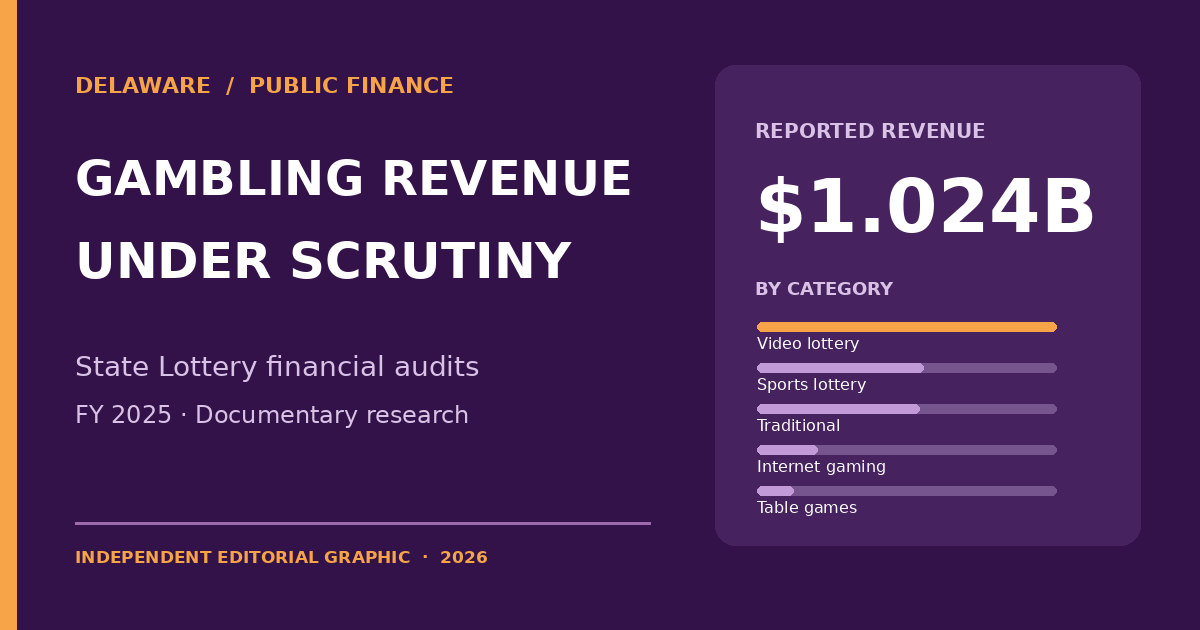
According to the Annual Comprehensive Financial Report (ACFR) for the fiscal year ended June 30, 2025, total Delaware State Lottery revenue reached $1,023,724,241.
The previous year's total was $891,068,831, representing an increase of approximately 14.9%.
The composition of fiscal year 2025 revenue was as follows:
| Revenue Category | Revenue |
|---|---|
| Video Lottery (slot machines) | $422.50 million |
| Sports Lottery (sports betting) | $234.76 million |
| Traditional lottery products | $229.99 million |
| Internet Gaming (iGaming) | $85.49 million |
| Table Games | $50.99 million |
| Total | $1,023.72 million |
These figures require careful interpretation. Different gambling segments use different revenue recognition methods. For example, Video Lottery and Table Games revenues are presented on a net basis, while the Sports Lottery separately reports prize expenses.
Consequently, total Lottery revenue should not be confused with the total amount wagered by players, casino profits, or the amount ultimately received by the state treasury.
Sports betting provides a particularly revealing example.
In fiscal year 2025, recognized Sports Lottery revenue amounted to approximately $234.76 million. However, related prize expenses reached approximately $208.23 million, excluding certain commissions and other operating costs.
This demonstrates how substantially reported revenue can differ from the amount remaining after financial obligations are satisfied.

How Much Money Does the State Actually Receive?
Despite increased total revenue, direct transfers to Delaware's General Fund declined in fiscal year 2025.
According to the audited financial statements:
- $238.29 million was transferred to the General Fund, the state's primary operating fund.
- $53.76 million was transferred to the Department of Agriculture.
- $1.84 million was transferred to the Department of Health and Social Services.
Together, these amounts represented $293.90 million in reported transfers to state government recipients.
By comparison, total transfers in the previous fiscal year were $297.39 million, including $244.81 million transferred directly to the General Fund.
Thus, while overall Lottery revenue increased, transfers to the General Fund declined by approximately $6.52 million.
The financial report attributes this trend, in part, to the relatively low financial yield of sports betting compared with wagering volume and declining traditional lottery sales.
This example illustrates why meaningful financial oversight must examine more than the amount of money collected from gamblers.
It must also evaluate expense structures, obligations to pay winnings, contractual commissions, and the mechanisms used to distribute net proceeds.
Who Regulates Casinos and Gaming Operations?
Financial auditing operates alongside a separate system of industry regulation.
The Delaware State Lottery carries out administrative and financial responsibilities within the state's regulated gaming framework.
The Delaware Division of Gaming Enforcement (DGE) serves a different purpose: enforcing laws governing gaming activity.
Its responsibilities include conducting background investigations of individuals associated with the gambling industry, investigating suspected criminal activity, and gathering information about threats to the integrity of regulated gaming operations.
Unlike the DGE, the Office of Auditor of Accounts focuses on governmental financial auditing.
This separation of responsibilities is fundamental.
Identifying accounting deficiencies, determining whether financial statements are fairly presented, and investigating possible criminal conduct are different forms of government oversight, each involving distinct authorities and procedures.
Internal Control Mechanisms
Published Delaware State Lottery financial reports describe an internal control framework designed to safeguard assets and support the reliability of accounting information.
The controls described include independent examinations of central gaming systems, reporting on their internal controls, testing of gaming equipment and software by independent laboratories, and background investigations involving employees, suppliers, and other gaming industry participants.
The agency also reports monitoring transfers to the state's General Fund on a monthly basis and having the ability to revise financial projections quarterly.
However, the existence of these procedures in official documentation does not guarantee that errors or irregularities cannot occur.
Evaluating their effectiveness requires examining actual audit results, identified deficiencies, management responses, and subsequent corrective actions.
The nature of the independent auditor's opinion is equally important.
For fiscal years 2024 and 2025, the published financial statements received an unmodified audit opinion. The reports also indicated that no findings requiring disclosure under Government Auditing Standards were identified.
This represents a favorable result within the defined scope of the financial statement audits.
Nevertheless, an unmodified opinion does not guarantee that fraud is impossible within the industry or that auditors examined every individual transaction.
Public Financial Reporting: Opportunities and Limitations
One of Delaware's advantages is the availability of historical financial reporting archives.
The Delaware Lottery publishes data covering slot machines, table games, sports betting, and online gaming. Some archives extend back to the early 2010s or earlier.
These materials allow researchers to analyze revenue trends, compare reporting periods, and examine the allocation of gaming proceeds.
However, not every published monthly revenue table has been independently audited.
Researchers must therefore distinguish between preliminary or operational statistics and officially audited annual financial statements.
In addition, publicly available financial reports generally do not disclose complete audit team rosters, internal correspondence, or the detailed allocation of responsibilities between government employees and contracted audit professionals.
Determining these matters may require separate public records requests.
Why Audit Transparency Matters
Delaware's experience demonstrates that oversight of gambling revenue involves much more than verifying accounting figures.
It is a system in which government agencies, independent auditors, casino operators, technology vendors, and recipients of public funds interact.
The fiscal year 2025 results illustrate why detailed financial analysis is necessary: more than $1 billion in recognized revenue resulted in approximately $238 million transferred directly to the state's General Fund.
Therefore, assessing the financial performance of the gambling sector requires more than knowing how much money was collected from gaming activity.
It also requires understanding who verifies the figures, who examines expenses, how obligations to the state are calculated, and how accessible the findings of these reviews are to the public.
The central finding is that Delaware has a legally mandated system of annual financial audits for its state lottery. However, a comprehensive understanding of gambling-related financial flows requires examining financial statements, contracts with independent auditors, industry revenue data, and government oversight records together.
Documentary Sources
- Delaware Code, Title 29, § 4816 — Post-Audit of Accounts and Transactions.
- Delaware State Lottery — Annual Comprehensive Financial Report, FY2025.
- Delaware Office of Auditor of Accounts — Lottery Audit Report for Fiscal Years 2024–2025.
- Delaware Division of Gaming Enforcement — Authority and Responsibilities.
- Delaware Lottery — Financial Reports and Historical Archives.
- Delaware Department of Finance — Advisory Committee Reports.
This article is based on official State of Delaware documents and published financial statements. Prepared November 5, 2026.